Friday, March 1, 2013

"Celebrating Kurtzman" Panel Discussion 3/19

portrait of
Harvey Kurtzman 
On March 19th, New York's Society of Illustrators (128 E. 63rd St) will host a two hour panel discussion and graphic presentation in conjunction with the upcoming Harvey Kurtzman retrospective (opening 3/9 and curated by Monte Beauchamp and Denis Kitchen) "CELEBRATING KURTZMAN" with graphic humorists Drew Friedman, Robert Grossman, Al Jaffee, Arnold Roth, and moderated by Peter Kuper:

All about "The Art of Harvey Kurtzman" show:
http://www.societyillustrators.org/The-Museum/2013/Harvey-Kurtzman/The-Art-of-Harvey-Kurtzman.aspx

the rough cover art for MAD # 1 by Kurtzman
will be on display at the show
Space is limited for the panel discussion, so if you plan to attend, it would be smart to purchase your tickets ahead of time.

Celebrating Kurtzman
A panel discussion with Drew Friedman, Robert Grossman, Al Jaffee, Arnold Roth and moderated by Peter Kuper


March 19, 2013  6:30 p.m. - 8:30 p.m.

Legendary artists Drew Friedman, Robert Grossman, Al Jaffee, and Arnold Roth will discuss the life and works of Harvey Kurtzman with a panel moderated by Peter Kuper.  

Tickets
$15 non-members, $10 members, $7 students/seniors

ABOUT THE ARTISTS

Drew Friedman is an award-winning illustrator whose work regularly appears in dozens of major publications.  For years he was renowned for his "stippling" style of caricature, employing thousands of pen-marks to achieve photographic verisimilitude, but in recent years Friedman has switched to painting.  His painstaking attention to detail and parodies of Hollywood icons is widely admired.  Friedman's work has appeared in Entertainment Weekly, Newsweek, Time, The New York Times, The Wall Street Journal, The New Yorker, The New Republic, The New York Observer, Esquire, RAW, BLAB!, Rolling Stone, and MAD Magazine.  He is a graduate of SVA and studied under such legendary masters as Will Eisner, Ed Sorel, Stan Mack, Arnold Roth, Art Spiegelman and Harvey Kurtzman.  

Robert Grossman is a New York artist whose work has appeared in The New York Times, The Nation, The New Yorker, The New York Observer, Rolling Stone and many other publications.  Grossman also works as a sculptor, filmmaker, and author and has published numerous titles including ZooNooz and O-MANLAND, an online compilation of strips focusing on the 2008 presidential race.  

Al Jaffee is best known for his satirical work in MAD Magazine, and today remains a regular contributor having only ever missed one issue of MAD in the last 57 years. Jaffee's trademark feature, the Mad Fold-in, was created in 1964 and a four-volume boxed set of hardcovers,The Mad Fold-In Collection: 1964-2010, was published by Chronicle Books in September 2011.  In 2008 Jaffee was honored by the Reuben Awards as Cartoonist of the Year. He has also received the National Cartoonists Society Advertising and Illustration Award in 1972, its Special Features Award in 1971 and 1975, and its Humor Comic Book Award in 1979. 

Arnold Roth has been a humorous illustrator and cartoonist all his life and, for most of that time, has freelanced, snatching a living by hustling one assignment after another in a highly competitive market.  Roth's big breakthrough came in 1957 when he started working onTrump, Playboy's satiric magazine, and on Humbug, a more penurious production, both the inventions of Harvey Kurtzman.  His work has appeared regularly in major magazines including Sports Illustrated, Esquire, Holiday, Time, The New York Times, The New Yorkerand countless others.  In 1983, Roth was elected president of the National Cartoonists Society and the next year received the NCS Reuben Award as Cartoonist of the Year.    

Peter Kuper's illustrations and comics appear regularly in Time, Newsweek, The New York Times, and MAD, where he illustrates SPY vs. SPY every month.  He has written and illustrated many books including Comics Trips, a journal of an eight-month trip through Africa and Southeast Asia.  In 1979 he co-founded the political comix magazine World War 3 Illustrated.

More info about the panel:
http://www.societyillustrators.org/Events-and-Programs/Lectures/2013/Celebrating-Kurtzman/Celebrating-Kurtzman.aspx

This was my 2012 Harvey Kurtzman memoir for THE COMICS JOURNAL: "SERIOUSLY FUNNY":
http://www.tcj.com/seriously-funny/

Tuesday, February 26, 2013

Aunt Bee, or Not Aunt Bee?


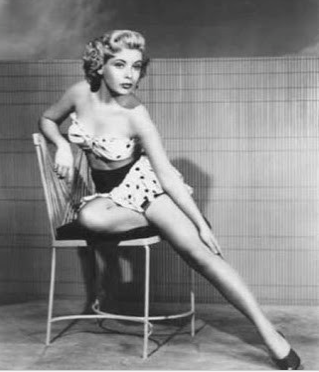
Gloria Dehaven

A photo has circulated on various "when they were young" and "urban legends" sites with the claim that it's a young, hot and pouty "Francis Bavier", aka "Aunt Bea" of The Andy Griffith Show. The caption claims the photo is from "around 1936", but It's actually a publicity still of actress Gloria DeHaven from 1949 for the film Yes Sir, That's My Baby which co-starred Donald O'Connor.

Dehaven, born in 1925 was 24 when the photo was taken. Frances Bavier, born in 1902, would have been 47 in 1949 and never posed for any "Cheesecake" photos. When she was younger she was a Broadway stage actress:

 Another clue that the claim is bogus: the real spelling of Bavier's first
name is "Frances", not "Francis", and her beloved character's name on
the show was spelled Bee, not Bea, (a common mistake), as captioned
with the photo:
Francis Bavier – better known as Aunt Bea on the Andy Griffith Show.
(Photo taken around 1936)

 Some publicity photos of Gloria DeHaven from Yes Sir, That's My Baby:

.


a scene with Donald O'Connor

and the film's poster (featuring BOOPKINS):


 Here's a photo of the younger Frances Bavier...


and another:

If you are looking for Aunt Bee posed in a sexy two-piece bathing
 suit, you've come to the right place:

my portrait of "TV Babe" Aunt Bee, originally
 published in TV GUIDE

Thanks to Richard Samson


Monday, February 25, 2013

Portrait of Charles Bukowski

 The Laureate of American lowlife                                                                  
Charles Bukowski was born in Germany in 1920, the only child of an American soldier and a German mother. At the age of three, he came with his family to the United States and grew up in Los Angeles. He attended Los Angeles City College from 1939 to 1941, then left school and moved to New York City to become a writer. His lack of publishing success at this time caused him to give up writing in 1946 and spurred a ten-year stint of heavy drinking. After he developed a bleeding ulcer, he decided to take up writing again. He worked a wide range of jobs to support his writing, including dishwasher, truck driver and loader, mail carrier, guard, gas station attendant, stock boy, warehouse worker, shipping clerk, post office clerk, parking lot attendant, Red Cross orderly, and elevator operator. He also worked in a dog biscuit factory, a slaughterhouse, a cake and cookie factory, and he hung posters in New York City subways.
Portrait of author Charles Bukowski, now available as a large (very) limited edition print, can be ordered here:
http://www.drewfriedman.net/prints/bukowski.html
Bukowski published his first story when he was twenty-four and began writing poetry at the age of thirty-five. His first book of poetry was published in 1959; he went on to publish more than forty-five books of poetry and prose, including Pulp (Black Sparrow, 1994), Screams from the Balcony: Selected Letters 1960-1970 (1993), and The Last Night of the Earth Poems (1992). He died of leukemia in San Pedro in 1994.

 This is my newly completed portrait of Charles Bukowski, who I never met, although I illustrated a series of his short stories ("Notes of a Dirty Old Man") for High Times magazine in 1993 when he had (briefly) become a regular contributer. (Robert Crumb has also drawn Bukowski and his stories on numerous occasions) Bukowski was very pleased with my depictions of his sad characters and sent this letter to the editor, Larry "Ratso" Sloman:
This is the artwork for the story he's referring to, "There's No Business like Show Business",
from the April 1983 issue of High Times:

                                                                            Bukowski biography notes via Good Reads 


Thursday, February 21, 2013

The Lost Drawings of George Wachsteter Auction


David Brinkley by
George Wachsteter

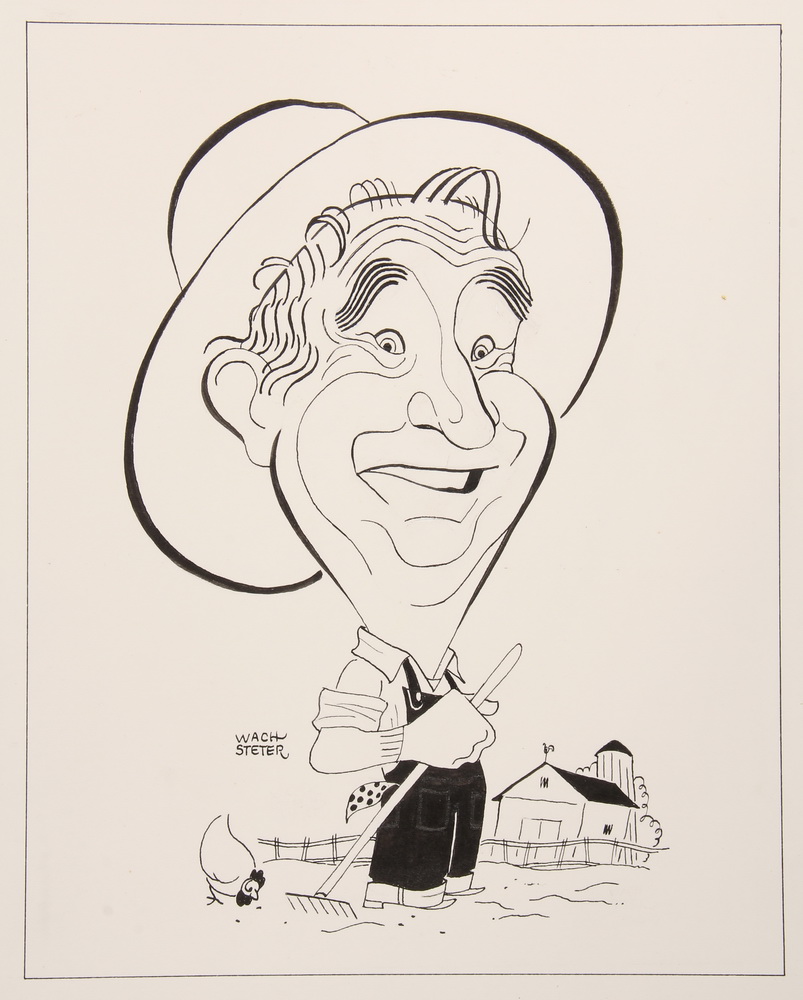
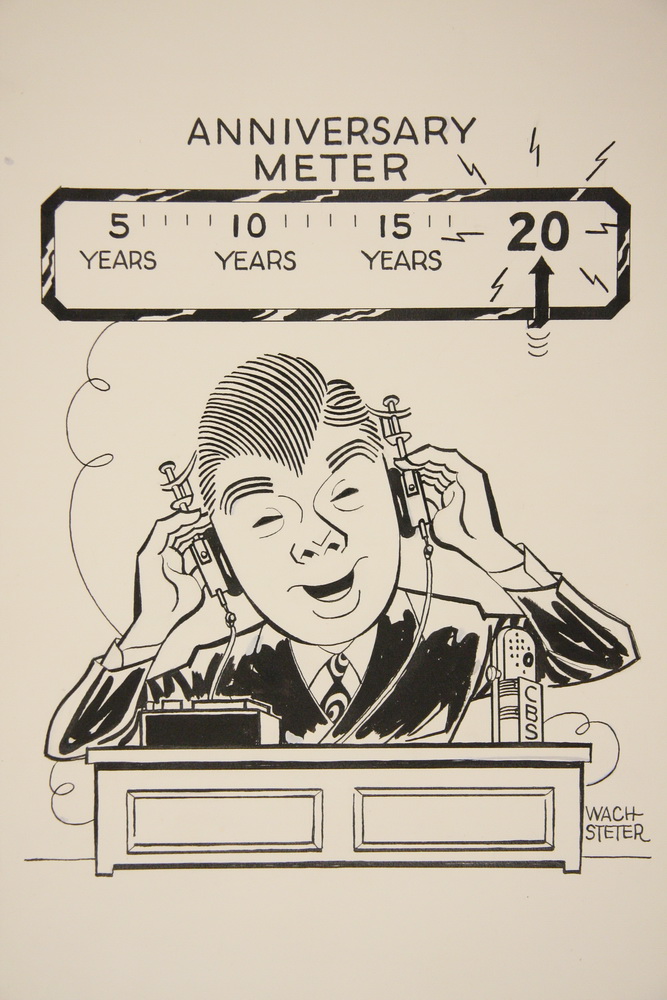
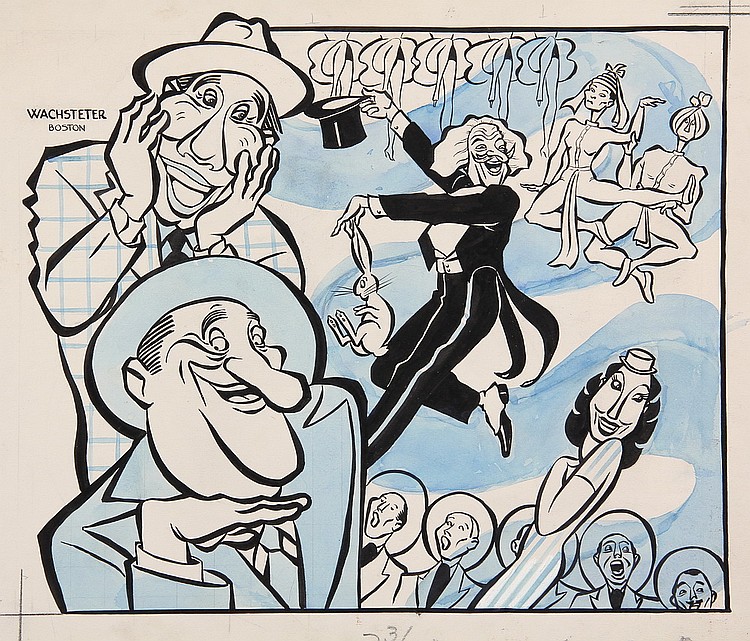
On March 24, the Thomaston Place Auction Galleries in Thomaston Maine will host a one-day auction featuring "The Lost Drawings of George Wachsteter", a mind-boggling collection of original art spanning four decades from the estate of Wachsteter, at one time one of the most celebrated caricaturists of the mid-twentieth century,  now all but virtually forgotten:

http://www.artfact.com/auction-catalog/one-day-auction-the-lost-drawings-of-g.-wachsteter-l9uonikmkg

Thanks to the efforts of a few longtime admirers of his incredible art, among them Leonard Maltin, Mike Lynch, yours truly and the caricaturist Zach Trenholm, who made a pilgrimage to Elmhurst Queens to visit the aging and forgotten Wachsteter in his final years,  George Wachsteter's work will receive the attention and inevitable revival it so richly deserves, (and hopefully an anthology). This is my blog tribute to Wachsteter from 2012:
http://drewfriedman.blogspot.com/2012/03/lost-art-of-george-wachsteter.html

I'm showing just a sampling here (in no particular order) of some of the original Wachsteter caricatures and illustrations that will to be auctioned on the 24th. Full descriptions, including names, dates, and publications, as well as rough art and printed covers can be found on the auction catalog site:
http://auctions.thomastonauction.com/asp/searchresults.asp?st=D&sale_no=302&ps=25&pg=28&view=view1#103000

The majority of work represented in the auction was created for the weekly cover of the New York Journal-American Pictorial TV section. When the Journal- American ceased publication in the late sixties and Wachsteters vision faltered, his career virtually came to a halt.

Looking at his work, you might assume that George Wachsterer was perhaps greatly influenced by the legendary Al Hirschfeld, who Wachsteter frequently alternated with at the New York Times in the forties, but consider that they were each contemporaries and both quite celebrated in their day. They were also both clearly influenced by the great caricaturist Miguel Covarrubias. Enjoy!

My thanks to Martin Gostanian
4 Broadway composers

Eddie Cantor, The Colgate Comedy Hour
4 for Texas

What's My Line?

Walter Brennan/The Real McCoys
Five TV Comedians

1950 Broadway directors

All-Star review

The Ann Sothern show

Broadway Playwrights, 1949

Bells are Ringing

Milton Berle, Happy/Sad

Jack Benny, Milton Berle

Jackpot Bowling with Milton Berle

the Milton Berle show

Bing Crosby

Ray Bolger

Ray Bolger

Jay North, Boris Karloff

George Burns looks at comedy

Captain Kangaroo

Car 54 Where Are You?

Art Carney

Johnny Carson

Carson & NBC Peacock

Danny Kaye

David Brinkley

1949 poster design

Dick Clark

Dizzy Dean

Don Amache

the Donna Reed Show

the Dick Van Dyke Show

Ed Sullivan, Ringmaster

Ed Sullivan at Freedomland

Ed Wynn

Joe E. Brown

Joe E. Brown

George S. Kaufman

Eric Blore

Bob Hope

Lowell Thomas

Ernie Ford as George Washington

Ernie Ford Paintings

Ernie Ford, Charlie Weaver

Fanny Brice

Allen Funt

Reggie Van Gleason

Arthur Godfrey

"Hit the Deck" at the Jones Beach theatre

The Alfred Hitchcock Show

Sid Caesar/Holiday on Wheels

Hugh Downs

Petticoat Junction

Jerry Lewis watercolor

Jerry Lewis, Garry Moore

Jerry Van Dyke

Jimmy Stewart

1964 Democratic convention with LBJ

My Little Margie

My Little Margie

Lucy/Desi Comedy Hour with Tallulah Bankhead

The Lucy Show

Lunt & Fontanne

cast of It's A Mad, Mad, Mad, Mad World

cast of "Uncle Willie" (with Menasha Skulnik)

The Munsters

My Favorite Martian

The NBC All-Star Review

Walter Matthau, Art Carney, "The Odd Couple"

Olson & Johnson

Oscar Levant

1946 Radio Stars

Red Buttons

Rudy Vallee

Sammy Kaye

The Defenders

"The Great Gleason Express"

The Jackie Gleason Show

Tom Ewell

Wagon Train

Walter Pigeon

Wayne & Shuster

Will Rogers

How to be a Jewish Mother

The Umbrellas of Cherbourg

Comp art for the NBC Book of Stars